
· by Michael Blair, Nashville's Remodeling
Most renovations are lived through. Whether that is sensible depends less on the size of the project than on which rooms it takes out, for how long, and whether the work will disturb anything you should not be breathing. On a whole-home remodel we settle that question before the first wall is opened, because the answer changes the order the rooms are done in.
Which renovations can you comfortably live through?
A single bathroom in a house that has another one, a bedroom, or flooring done one room at a time are all livable. Most exterior work is too, with one question on an older house: the EPA’s lead renovation rule requires firms working on homes built before 1978 to be EPA- or state-certified and to use certified renovators who follow lead-safe work practices, so on a pre-1978 house ask how the crew will handle the painted surfaces.
These are disruptive rather than disabling, and the saving on accommodation is real.
Which projects make staying at home unrealistic?
A whole-house floor refinish takes every room out of use at once, and the finish gives off fumes while it goes down. The EPA’s page on volatile organic compounds notes that paints, varnishes and wax all contain organic solvents and can release them while they are being used, and it advises plenty of fresh air. How long a particular finish needs before the rooms are usable is on that product’s data sheet, so ask the flooring crew for it. Any project that takes out the only bathroom or the only kitchen for weeks belongs on this side too.
So does anything that needs the power or water off for long stretches, and any asbestos or lead abatement. On abatement the federal guidance is about the work area rather than the whole house: the lead work practice standards in 40 CFR 745.85 require firms to post signs warning occupants to stay outside the work area, and the EPA’s guidance on vermiculite insulation says to hire a professional asbestos contractor before a remodel that would disturb it. Whether the household should leave the house altogether is a question for the abatement contractor, and we ask it before that work goes on the schedule.
- Second bathroom available: staying is fine
- Only kitchen out for six weeks: set up a real temporary one
- Whole-house floor refinish: plan to be elsewhere until the finish has cured
- Abatement work: stay out of the work area, and ask the abatement contractor whether to leave the house
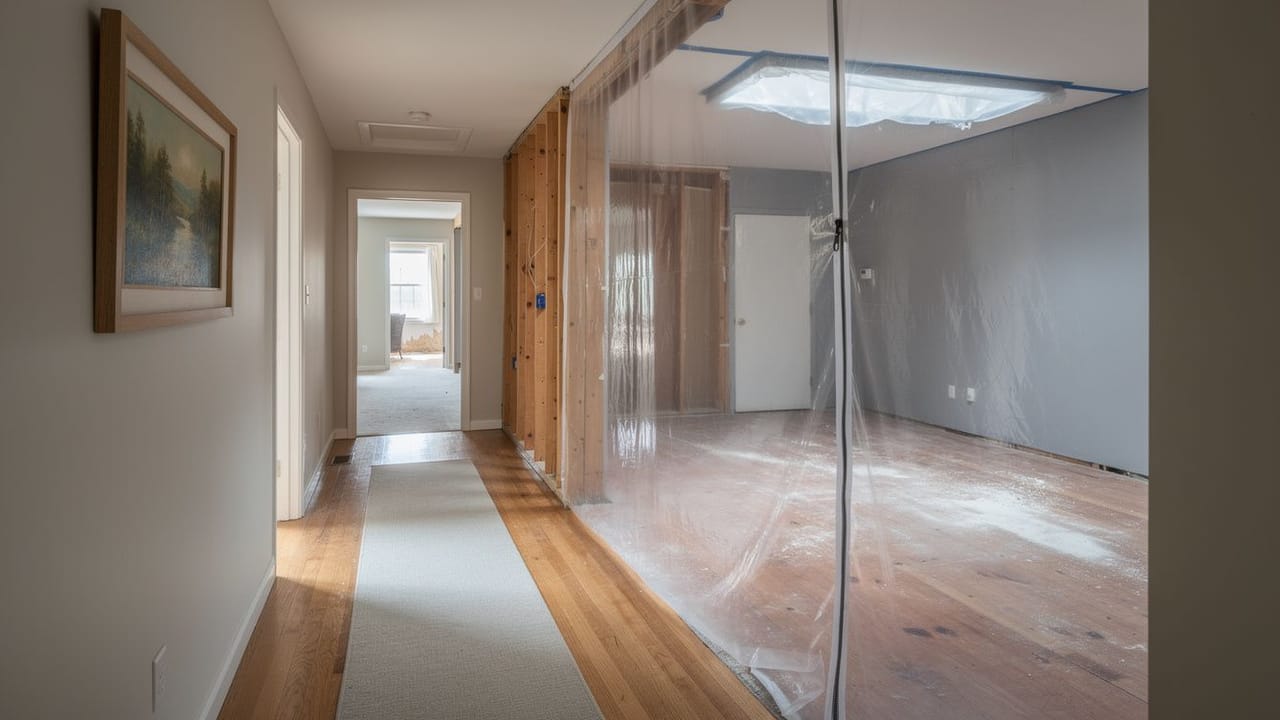
- Dust containment matters more than people expect
Dust containment
Ask specifically whether it is included. On lead-safe work it is spelled out in the same federal standard, which requires every duct opening in the work area to be closed and covered with taped-down plastic sheeting, doors into the work area to be covered so workers can pass through while the dust stays inside, and furniture, rugs and window coverings to be removed or sealed under plastic. For other work it comes down to what the quote includes, and the same setup is worth asking for: sheeting at openings, zip doors, covered supply and return vents in the work area, and negative pressure where it matters.
Without it, drywall and demolition dust can travel well beyond the work area. In an older house that dust can carry more than drywall: the EPA’s asbestos overview explains that asbestos-containing material releases fibers into the air when it is disturbed or damaged, and it names remodeling among the ways that happens. Our post on lead paint and asbestos in older Nashville homes covers what to test before demolition starts.
Setting expectations with the crew
Agree working hours, where they park, which bathroom they use, how the house is secured at the end of each day, and who you call when something comes up.
These sound minor and they are the things that cause friction over a six-week job. Agreeing them at the start is easier than raising them in week three, and they are worth putting on the table when you ask us for an estimate.
Sources
- U.S. EPA, Lead Renovation, Repair and Painting Program Rules — Firms working on homes built before 1978 must be EPA- or state-certified and use certified renovators following lead-safe work practices
- 40 CFR 745.85, Work practice standards (eCFR) — Signs warning occupants to stay outside the work area; ducts in the work area closed and covered with taped-down plastic; entry doors covered so dust stays inside; furniture, rugs and window coverings removed or sealed
- U.S. EPA, Volatile Organic Compounds’ Impact on Indoor Air Quality — Paints, varnishes and wax contain organic solvents released during use; provide plenty of fresh air
- U.S. EPA, Protect Your Family from Asbestos-Contaminated Vermiculite Insulation — Hire a professional asbestos contractor before a remodel that would disturb vermiculite insulation
- U.S. EPA, Learn About Asbestos — Asbestos-containing material releases fibers when disturbed or damaged, including during remodeling
FAQ
Living in the House During a Renovation — questions
Should I move out during a renovation?
It depends on which rooms it takes out. A second bathroom makes staying comfortable; losing the only kitchen for six weeks means committing to a real temporary setup. A whole-house floor refinish is worth leaving for, because every room is out of use at once while the finish gives off fumes. For asbestos or lead abatement, stay out of the work area and ask the abatement contractor whether the household should leave.
How bad is renovation dust?
Without containment, drywall and demolition dust can travel well beyond the work area. Ask specifically whether containment is in the quote: plastic sheeting at openings, zip doors and covered supply and return vents. Do not assume it is included; if it is not written into the quote, it may not be.
What should I agree with the crew before they start?
Working hours, parking, which bathroom they use, how the house is secured at the end of each workday, and how they contact you. These sound trivial and they are exactly what causes friction over a multi-week project. Agreeing them on day one is much easier than raising them later.
How do you dust-proof your home during a renovation?
Contain the work area. Ask for plastic sheeting at the openings, zip doors, supply and return vents in the work area covered, and negative pressure where it matters. Furniture, rugs and window coverings come out or go under plastic, and none of it should be assumed unless the quote says so.